Lee Ufan
South Korean sculptor, painter, writer and philosopher, Lee Ufan was born in 1936 in Kynongnam and lives between France and Japan. He studied calligraphy, poetry and painting at the College of Kyongnam and Seoul National University.
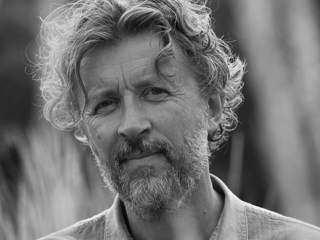
Lee Ufan portrait by Claire Dorn.
Awarded the UNESCO prize in 2000 and the Praemium Imperiale for painting in 2001, Lee first rose to prominence in the late 1960s as one of the leading theoretical and practical proponents of the avant-garde Mono-ha (“school of things”) movement.
Associated with a group of young artists in Tokyo’s Shinjuku district, including Sekine Nobuo, Suga Kishio, Yoshida Katsuro, Koshimizu Susumu, and Katsuhiko Narita, the Mono-ha movement proposed an artistic practice that focused not on representation but instead on the nature of materials and the network of relationships that arise among an artwork, its site, the artist, and the viewer.
Lee Ufan, Relatum – She and He (2010/2023). Steel, natural stone. Photo by Photo Albertine Dijkema.
Made from steel and natural stone, Lee’s Relatum series, which he has developed since 1968, embodies his minimalist philosophy. By creating a dialogue between contrasting materials, he challenges Western materialism, shifting art from a static object to an experience of encounter. Leaving the materials largely unaltered, Lee arranges them with careful attention to the nuances of each site. His practice of placing contrasting materials, such as stainless-steel plates and boulders, in dialogue heightens our awareness of the world “just as it is.”
In 1991, Lee began his series of Correspondence paintings, consisting of just one or two grey-blue brushstrokes made of a mixture of oil and crushed stone pigment applied to a white surface. The relationship between brushstroke and canvas echoes that between stone and iron plate, highlighting the dialectic between painted and unpainted, and occupied and empty space, which lies at the heart of Lee’s practice.